mental health in schools
One of the issues I care about is mental health in schools. Students are under a lot of pressure from assignments, projects, hobbies, and personal life, but schools don’t provide enough mental health resources. Many students struggle in silence because they don’t know where to get help.
You don’t think you could ever really do anything about it, do you?
I get why you’d say that. It’s a big issue, and changing school policies sounds hard. But here are some things that schools can do. Schools can offer more mental health education, hire more counselors, and create safe spaces for students to talk. Even just reducing the stigma around mental health could cause more students to get help.
But schools don’t have the money for that. Wouldn’t students just ignore these resources anyway?
Money is definitely an issue, but some schools have found ways to fund mental health programs, like donations or the school prioritizes finances for that cause. As for students ignoring resources, that’s why it is important to make things like that known among students. If the importance of mental health is made aware to students, more students will take it seriously.
Even if a few schools do that, isn’t it just a drop in the bucket?
If even one student gets the help they need, it’s worth it. Plus, change spreads, if one school improves mental health support, others might follow. Students who grow up in supportive environments benefit much more than students who don't.
Pollan answers the question of “Why bother?” by explaining that individual actions, while small, are essential for larger change. He argues that personal responsibility, like growing one’s own food or reducing energy use, helps fight climate change by changing cultural norms. If enough people take action, it will put pressure on industries and businesses so that policies can change. He sees action as necessary, even if the impact is small, it’s better than doing nothing.
Pollan and Wendell Berry argue that over-specialization in modern society disconnects people from the basic skills needed for sustainability. This has led to increased dependence on industries that prioritize efficiency over environmental and social well being. The believing game supports this by showing how self-sufficiency, like growing food or fixing things reduces reliance on systems that are not sustainable. The doubting game gives concerns about whether individual efforts can solve global problems. A balance is needed while specialization brings efficiency, knowledge and self-reliance could create a healthier society.
Pollan’s essay shows the importance of defining the problem, making the issue relatable, and giving realistic solutions. He also uses evidence and reasoning to support his argument. For our research proposal, we should make sure the problem is specific, supported by statistics, includes credible sources.
Problem: Student mental health issues are rising but many schools don't have the resources to provide the proper support. Anxiety, depression, and stress is common among students and impacts students academic performance and overall well-being. Schools focus heavily on good grades and performance but often neglect students emotional and psychological needs.
Why it matters: Mental health affects learning, relationships, and future success. When students struggle with mental health issues, it leads to lower grades, higher dropout rates, and long-term challenges. According to the National Alliance on Mental Health, "One in six U.S. youth aged 6-17 experience a mental health disorder each year, and half of all mental health conditions begin by age 14". "Undiagnosed, untreated or inadequately treated mental illnesses can significantly interfere with a student’s ability to learn, grow and develop. Since children spend much of their productive time in educational settings, schools offer a unique opportunity for early identification, prevention, and interventions that serve students where they already are."
The solution: Schools should incorporate mental health programs and resources, including hiring more counselors, offering peer support groups, and including mental health education into the curriculum. Change policies would also be beneficial. According to the National Alliance on Mental Health, "Policies should also consider reducing barriers to delivering mental health services in schools including difficulty with reimbursement, scaling effective treatments, and equitable access". Funding can come from state grants, charities, partnerships, and financial saving of existing resources. Schools should also create safe spaces where students feel comfortable getting help.
Impact: By prioritizing mental health, schools can create healthier learning environments, improve academic performance, and equip students with lifelong skills. Addressing this issue now can prevent more severe problems in the future and help students reach their full potential.
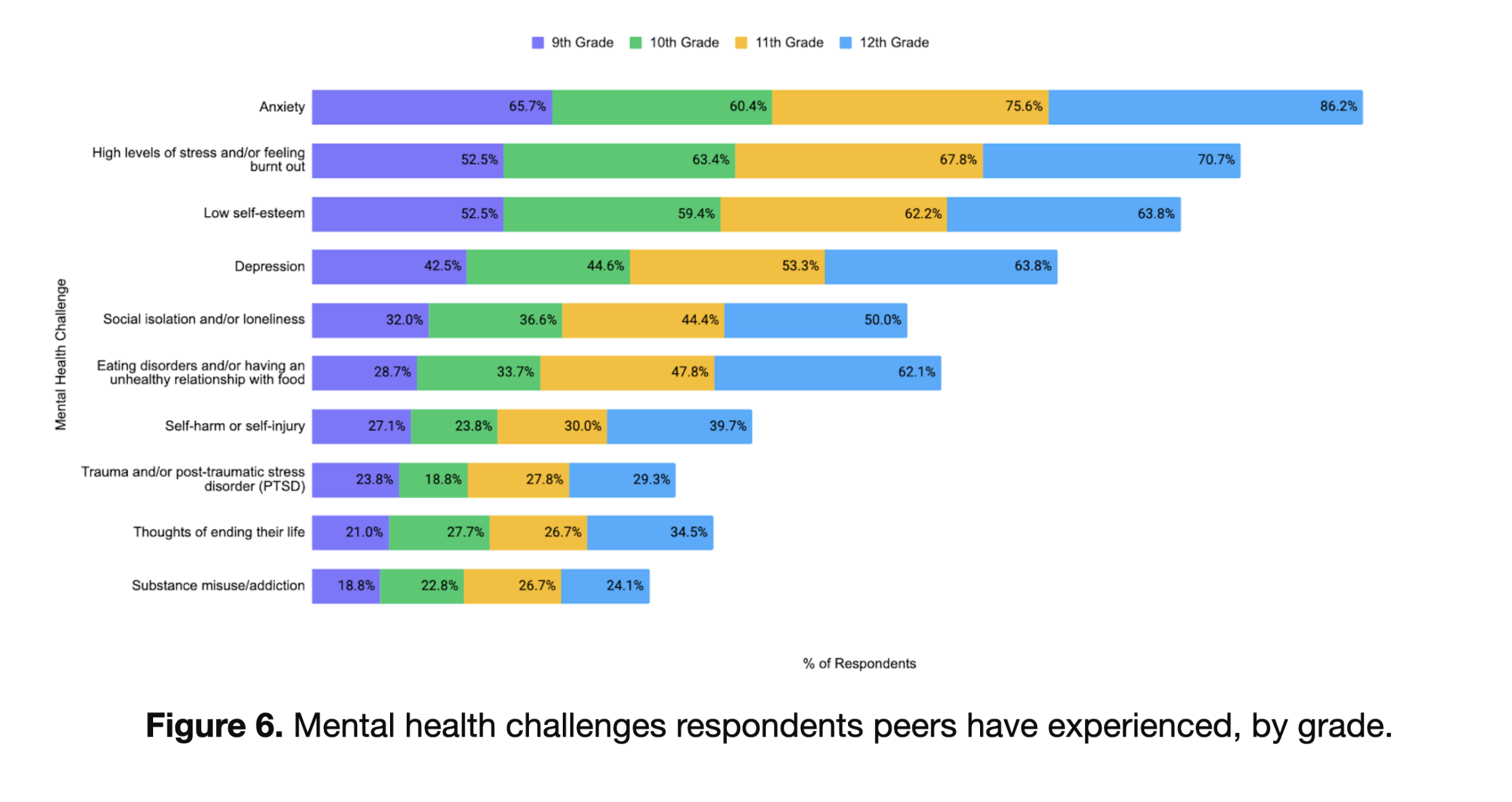
Graph: The graph below is from the article titled "2024 State of Youth Mental Health (A Student-Led California Report)" by Meadowlark Monaghan.
 Source Links:
https://www.nami.org/advocacy/policy-priorities/improving-health/mental-health-in-schools/https://aimymh.org/2024-state-of-youth-mental-health/
Comments
Post a Comment